Showing posts with label Research. Show all posts

Thursday, 5 July 2012

Research


This is just an excerpt from Paul D.Miller (DJ Spooky)'s Rebirth of a Nation that was performed live in various locations. I found this example from the book "New Media Art" by Mark Tribe / Reena Jana. Unfortunately when I took the book home from the library I realised it was in Italian, but fortunately (thanks to Italian TV channels in Malta) I can read Italian and understand it!

The authors say that most New Media artists are criticized for now being familiar with historic art movements that have contributed to New Media such as Dadaism and Popart. Most of the time this is untrue, and this is reflected in some works of New Media artists, in this case Paul D.Miller's Rebirth of a Nation(2002) that was a live performance when he remixes D.W. Griffith's Birth of a Nation, whilst assembling improvised sound.


In the same book I have also come across "Brandon" by Shu Lea Cheang, that is a true story about Teena Brandon who was a twenty one year old girl who was raped and killed after trying to be passed on as a man. (I have also seen this interpreted as a film in "Boys don't cry" (1999).

(The following in an English translation from the book)
The artist Shu Lea Cheang was commissioned by the Guggenheim to produce a web-based work of art that expored Teena Brandon's story in an experimental manner, non-linear, in order to communicate the fluidity and ambiguity of sex and identity in contemporary societies.


"Shu Lea Cheang's 1998 work "Brandon" is a multifaceted web project that uses the nonlinear and participatory nature of the Internet as a means to explore and illuminate Brandon Teena's tragic story. From the opening image of morphing gender signifiers, Cheang propels the viewer into a probing investigation of human sexuality. It is an inquiry that utilizes hyperlinked images of a disembodied human form, once-live chat rooms on the subject of crime and punishment, and graphic moving images in order to illuminate the wide-reaching effect of Brandon's life and death. Exploiting the highly mutable "skin" of the Internet, Cheang reveals how this emerging virtual environment enables individuals to inhabit and play with different gender roles and characters. A prime example of "cyberfeminism," Brandon utilizes technology as a means to break down social assumptions about gender in both the realm of technology and in society at large." Guggenheim(accessed: 2012)

Unfortunately the website does not seem to be available online, however I found it to be relevant to my body of work since it deals with true stories, interactive imagery and non-linearity.

Yet another website that my programmer found and that reminds me of my work is this one and this time rather than in Italian, it's in German. I believe it is a preview of various artists / student works. Each pictures can be dragged around and can be clicked to direct to specific works. I really like the white space however in my case I fear it might not work because it uncovers the somewhat ugly borders of the videos.

Tuesday, 15 May 2012

New video / inspirations

I'll start this post by including some screenshots from my latest video:


I hope these images speak for themselves. The video is simply a 1 minute take of a couple sleeping together. In the last few seconds we can see another hand coming from behind the girl. I'm quite happy with the video because I think it managed to capture the essence of the story in just one shot. I also like the fact that the last few fames make it slightly humorous. The story was not filmed with the heads cut off but I felt that the identity of the couple was not needed, especially of the guy at the front, who all of sudden loses a bit of importance once the other hand is introduced.

Ok so aside from this, this week I am 'shadowing' two German lecturers at my college who are teaching and experimental film module to the BA Media students. Shadowing basically means I have to see what they are doing so once they leave I can carry on the lectures myself, and I can teach the module next year (most probably). Although most of the examples given in class are familiar to me, I have come across certain works that I hadn't seen before and that I have found to be interesting and even relevant to my Masters projects.


"A Movie is a 1958 experimental collage film in which Bruce Conner put together snippets of found footage, taken from B-movies, newsreels, soft-core pornography, novelty short films, and other sources, to a musical score featuring Respighi's The Pines of Rom" (youtube, 2012)


"Directed by Peter Mays. A sight/sound combine of exotic imagry shot semi-randomly in superimposition off a TV and then cut to make a fast moving but extremely ambiguous "story". GORILLA moves through modern man's myth mind like a runaway train bursting at the seams. Prize at Ann Arbor Film Festival, 1967." (youtube, 2012)


Harry Smith's drug inspired mirror animations.

Besides the history of experimental film we are also having discussions about 'experimental' film in general, such as the fact that dreams are one ways to be experimental in traditional films as they are purely surreal and therefore allow for plenty of ways to portray the distortion of time. We also discussed the difference between MTV style editing and experimental; MTV being for the masses (albeit the young generation masses) whilst experimental is more personal and much more risky. One of the lecturers expressed that common everyday youtube videos are perhaps closer to experimental than music videos, although the pity is that the subject is always the same; cats / accidents / food / sports, since most people like the same things.

The subject of minimalist and reduction was of course a prominent one, where the lecturers constantly told the students to reduce to the extreme. They told them how minimal projects are often not taken seriously by the viewer, however they are extremely difficult to copy and reproduce because they are so simple, that a project which is even remotely similar, cannot be said to be inspired from the original since the concept is so minimal. Therefore this makes minimal experimental art rather unique. They gave us an example of Paul Sharits' Ray Gun Virus, that was essentially an experimental film using just flickering colour. The point here was not to tell a story but to instigate a mood, and the conclusion was that if a visual piece manages to change the viewer's mood, then it has definitely done its job.


Ray Gun Virus (with sound!)
1966
According to artist, sound is to be turned to max volume.

"Although affirming projector, projection beam, screen, emulsion, film frame structure, etc., this is not an "abstract film"/projector as pistol/time-colored pills/yes=no/mental suicide and then, rebirth as self-projection. "... just colors and strobe ... 'light-color energy patterns (analogies of neural transmission systems) generate internal color-time shape and allow the viewer to become aware of the electrical-chemical functionings of his own nervous system' ... It's true." - David Curtis, International Times "RAY GUN VIRUS is a work in which no images appear yet one can get pure identity on film. ... projected film itself makes the viewer aware of where he stands. RAY GUN VIRUS is not so-called 'Psychedelic Cinema' but even more and goes beyond it through Sharits' bright clarification of the media." - Takahiko Iimura, Film Art Exhibition: Fourth Int'l Experimental Film Competition, Knokke-Le-Zoute; "Twenty Years of American Personal Film" anthology, National Museum of Modern Art, Tokyo, 1966. Collections: Museum of Modern Art, NY; Royal Archive of Belgium." (youtube, 2012)

Finally I will be creating a "Manifesto" category in my blog to explain the boundaries and rules of my project, and to define exactly why I have chosen this process and what I am expecting from the viewer.

Friday, 6 April 2012

Random Number Generators

In my Unit 1 feedback my tutor had suggested that I look at some Markov chains and just general random number generators. Together with my developer we have looked at how random numbers are generated in PHP, which is what we will be using to generate visuals and sounds in my project. We found out that PHP uses the Mersenne Twister

"The Mersenne Twister is an algorithm for generating random numbers.  It was designed with consideration of the flaws in various other generators. The period, 2^19937-1, and the order of equidistribution, 623 dimensions, are far greater.  The generator is also fast; it avoids multiplication and division, and it benefits from caches and pipelines." (Bellew.net) 

We found an interesting article that explained how a computer, which is essentially a logical machine, can never really generate a number that is completely random. It states that any man made algorithm can always be cracked, therefore only natural randomness is truly random. (source) Certain random algorithms tend to pick out a seed which is likely to create a totally random number, such as the time of day. However, as my developer pointed out, once a hacker identifies the seed, this too can be cracked. Of course my project is not about security, therefore hacking is not really an issue, however it could be interesting to generate a different seed perhaps through something natural.

I'm also thinking about how I could perhaps use natural chance to select the music for the project. However I think that for the computer generated 'chance' I will stick to the PHP random number generator. Of course  I have set up a number of boundaries in order to avoid slow loading speed, but still keep the viewer interested. The boundaries I have set for the interface are explained more in detail in an earlier post.

Tuesday, 3 April 2012

Reflective Writing: The Authenticity of Digital Art

The Authenticity of Digital art (reflections on Digital Art: The Quest for Presence taken from: Dunking bird productions)

One of the many arguments against digital art, or perhaps the reason why it is sometimes snubbed off, is perhaps the question of whether or not digital art is authentic. I found this article particularly interesting because I have written about chance and authenticity in my research paper and I have quotes Jesse Schell who believes that we are at a time where people are demanding authentic and ‘real’ things rather than being drawn to the digital.

The article refers to German philosopher, Walter Benjamin who questioned the ‘presence’ of mechanical art as well as its ‘historical aura’ which is basically the effect of time of a piece of work. The fading and cracking paint work as work as the general wear and tear of a piece tends to give it a certain value. People tend to be fascinated by these elements and it is obvious in the way they approach vintage and old objects with a certain sense of longing. These effects are of course lost when a piece of work is exhibited on screen, although the nostalgia for 8 bit games is very popular so it is worth considering whether or not digital art has provenance or not even without the tangible qualities.

Of course the author reminds us that digital art cannot have any ‘original’ since it is made up of binary code, which is basically instructions for a construction on a screen. Digital art is in the article, linked to the invention of photography, which was one of the first mechanized ways of making art. The fact that it was so quick to take a picture (when compared to making a painting) the question of whether this should be art or not, often cropped up. If the camera could create an exact reproduction, how did this affect the authenticity of art?

“Perhaps Robert Rauschenburg's description, "the place between art and life", which he used to describe his work, now applies to life itself...the twilight zone of curious invention were such things as "post-modernism" can rise like toadstools from the debris.
In his twilight zone between art and life, Rauschenberg invented his aesthetics off. He got rid of the canvas, splashing paint on stuffed goats, tires, bed blankets. He created sculpture, attached it to a wall and applied paint. He stretched canvas and applied no paint or just one "non-color" of paint. He designed costumes and settings and sounds and let them loose with only slightly programmed or even random activity. Art no longer had to be "object" at all. His work released the first spores of something new, that marks a place in time after "modernism". This place being inhabited by, among other things, computers and digital art.”

The author goes on to say that although people often miss the ‘sensual pleasures’ of traditional art, in the time it takes to prepare to create a traditional piece, and artist can actually create more art. Rather than ‘wasting’ time watching paint dry (literally) and rather than risking to ruin a painting by overdoing it,  a digital artist can afford to keep adding and experimenting with the piece until he/she is happy with it. If it is ruined, taking a step back is of course possible by reverting to previous save points. Of course risk is one of the beautiful features of traditional art; it’s nice to know that a brush stroke has been made right on the first right. There is in fact a certain element of spontaneity and chance in this, which is sometimes hard to spot in digital art pieces.

“Synthesis is the strong suit for digital art. Bringing together old ideas and techniques in radically new ways, never before possible, is what the machine does best. Apply photo-techniques to paint, turn the machine loose, then edit it all back as if on a word processor. Drop shadows onto thin air. Texturize light. Smear pixels. Import the old and spit out the new...synthesize your imagination.”

Thursday, 22 March 2012

Empty Words Part 1 - Reflections & Thoughts

Part  1

Soft Sounds – rattlings, hushing and drops, echoes – playful voice of a woman comes in – saying random words out loud. Somehow the sound is very pleasant although unintelligible. Start to notice the sharp contrast between vocals and consonants. Sometimes she stretches the words and they are more like noises rather than whole worlds. There’s emphasis on single letters. Some moments of no voice over – this pause feels like it is part of the sound piece, like a period of waiting. Sometimes it sounds like abstract poetry and sometimes it sounds like a story / fairytale being read to a child. At a certain point it becomes hectic and almost aggressive.

Part II – My impession is that the voice seems less playful and calmer. The general atmosphere is less hectic. Much less rattles and rustles – much less noise in general. Softer sounds – a more natural ambience.

Notes from the Cover:

“A mix of words, syllables, and letters obtained by subjecting the Journal of Henry David Thoreau to a series of I Ching chance operations.”

“What was interesting to me was making English less understandable. Because when it’s understandable, well, people control one another, and poetry disappears.”

“A transition from language to music. It’s bewildering at first, but it’s extremely pleasurable as time goes on. And that’s what I’m up to.”

John Cage in a radio interview on Empty Words, 1974

(to be continued...)

Thursday, 15 March 2012

Sarah Scicluna's Robots

One of my students who is doing her thesis on mechanical Chance methods has produced some really interesting automatic drawings built by little 'robots' that she has constructed herself. The robots are essentially  moving machinery with an attached open pen that draws along the path that the robot decides to take. There are many features that I find extremely interesting in this project. The line itself is built from tiny little dots that immediately make it clear that the drawing has not been constructed by a human but by a machine. The lines themselves incorporate this very digital aesthetic, almost like a Processing sketch. This creates a cool contrast between the clearly traditional medium and the digital outline. 

Aside from the technical details however, I find that there could be an interesting argument about the authorship of the drawing. Of course the idea behind the process is Sarah's, but technically she is not doing any of the drawing herself. Is the robot the artist? Can one comment on the beauty of the composition of the piece when it was created by a mindlessly roaming robot? Can Sarah take credit for a drawing that took three hours to create, during which, she was baking cookies instead? The answer is of course, yes, because it was her concept all along, however the fact that the drawing looks so good in the end does get one wondering about the beauty of randomness and chance, and how the formal elements are still present in every sense even with such lack of control.


Friday, 6 January 2012

Catfish & Interface tests

Short film review:

Two days ago I watched the film 'Catfish' which is more of a documented story. It's about a photographer from New York city who is tricked into thinking he is exchanging messages with a dancer who in reality is a middle-aged woman. He tracks her down, together with two of his house mates who also happen to be filmmakers. The films is  as 'real' looking as you can get since it is in fact a real story. Most shots are over exposed, badly framed, too long and offer no real drama, and yet the film keeps you hooked until the end. There is no real good and evil within the plot; some climaxes but only to a certain extent. In general, I found this film extremely interesting and relevant, in the way it portrays betrayal in the online world, but rather than making a drama over it, it is solved in a very natural and human way and no technology overload, yet still providing a fantastic outcome.

source: Imdb
Today I carried out some interface tests. In the final application I wanted phrases to 'trick' the user, however I wasn't use how these would look with the films. Today I did my first test (the graphic designer in me made me choose the overused helvetica neue as a first trial) and I was not too pleased with the result.

I tried two options: 1. misleading phrases. 2. phrases from the stories. I will need to rethink how they will show up because at the moment they are looking VERY cheesy. I might just forget about the phrases completely and perhaps make the films / water colours themselves clickable. More brainstorming needed either way


*** a few minutes later ***

Just trying out another experiment where rather than phrases I have pixel-like rectangles that are always moving around the screen (perhaps even the films could move around) anyway... it would look something like this:
less obvious, more abstract


Tuesday, 3 January 2012

Black Mirror

I wish I had seen the three episodes of Black Mirror (created by Charlie Brooker) before I had written my research paper! Nonetheless I found this series extremely interesting and related to what I am doing. All three episodes are a reflection of the ever evolving social technology and how it is affecting (or destroying) our lives. Although slightly dramatic (of course, it's a drama) I think Black Mirror is a great interpretation of technology vs nature and an interesting negative view of the ubiquity of internet, social networking and video games.

I was mostly interested in the second episode "15 million merits", where the protagonists are stuck in what seems like a virtual prison. They are represented by a virtual avatar, and are constantly instigated to get points and rewards by not wasting water, eating healthy food and exercising (very similar to how Jesse Schell described the near future in his presentation 'Design outside the Box') although Brooker takes a negative perspective. He satirises Reality TV, making it look like the "Bad Guy" although simultaneously, for the protagonists it is the only way out of the prison. The ending is a perfect example of human nature and perhaps human selfishness where we see the main protagonist Bing, choosing "reality" and conformity over rebellion and uncovering the truth. We can see him staring through windows (or perhaps a screen) and drinking a glass of juice whilst admiring a natural landscape.

Thursday, 3 November 2011

Updated Structure

Man With a Movie Camera - Dziga Vertov
Now that I have started writing the essay, I have had to restructure several times, this is the one I'm working with at the moment: (based on the structure suggested by Kevin Fox during the chats)

IDEA: Chance & Database VS Traditional Narrative
Introduction
|
General Background of Traditional narratives VS General Background of Chance
Order/Regulated VS Disorder/Nature
|
Main Argument. Traditional Narratives VS Database Structures
(Various types, what database (modular/puzzle) offer that traditional don't. Are they a new species? Temporality. Examples, etc...)
|
Does the audience want meaning or chance?
|
Conclusion

Sunday, 30 October 2011

Reflective writing on chat & lots of writing to do...

How I feel right now, pic source 
After the brief discussion with Ed Kelly, I think I am on the right track when it comes to the essay, although I have to admit I am very much all over the place. I have started from chaos and now the order seems so difficult to achieve. No doubt this is the worst part of the essay - trying to mash everything together into an argument.

The problem was that the reading got slightly out of hand. I kept finding more and more material and just reading and underlining, and now I'm not sure if I have enough time to log it all. I still have a couple of journals I need to log and see if they fit with the rest of the research.

Amid all the confusion however, yesterday I came up with a structure which would involve three chapters in the essay:

The first part will deal with an intro on classical Narrative which will then lead to a discussion on Modular and Database Narrative and how it is perceived by the audience. Most of the disadvantages of new narratives seem to be the lack of meaning, therefore I will link this to Chapter 2 which deals with Chance, meaning and the author. Chapter three will continue from a discussion on the open-ended nature of chance and lack of meaning, and will lead to new interactive narratives, games, and contemporary modular films.

This is likely to change, however I think it should be a good starting point. Chapter one will have to be written this week.

Thursday, 20 October 2011

Abstract is up & I found a developer!

I have just put up my Abstract. It is still under construction however the basic idea for the essay is there. Today I have also met a girl who will be my developer for the project. We have decided to use Jquery and to create the project as a web application that can be viewed on screen / mobile / tablet. She will be sending me a test of how everything will work as a whole. Even though she's taking care of the development, she will be explaining how she did everything to me so I know how the application was constructed.

This is of course great news, because it will give me plenty of time to work on the videos.

We have also discussed the idea of making the website/application open to the public, whereas anyone can upload videos etc... however I felt that this would be a completely different project (although this could be done in the future perhaps). So instead we're thinking of letting the user share their chosen combination of video/audio/music.

Sunday, 9 October 2011

Reading

I have just been looking through the new Dynamic Views in Blogger and must say most look much better than the one I am currently using... the only problem is the label / tagging system... perhaps this will be fixed in the future, but until then I'm sticking with the 'old' layout for the sake of clear organisation.

So.. at the moment I am still editing footage every once in a while but I am mostly just reading and structuring my research paper which is due next month. I have been reading Aristotle's Poetics for Screenwriters - which I found to be slightly useful but mostly just a guide to 'sell your script to Hollywood' not really what I was looking for. I will be reading the real Poetics tomorrow (well, some of them at least!)

I have read Lev Manovich's Cinema and Digital Media and
Database as a Symbolic Form.
Moving Image after computerization - extending traditional elements of cinema
Steve Anderson's Select and Combine: The Rise of Database Narratives.
Doors to the Labyrinth by Marsha Kinder

I have read Modular Narratives by Allan Cameron
Chance from Documents of Contemporary Art
Parts of Cinema of Outsiders by Emanuel Levy
Part of Silence - John Cage
David Lynch - Catching the Big Fish
Story and Discourse by Seymour Chatman

There might be others but I have left some books at my workplace so I'll add these later...

Most of the transcripts are ready.
Before I go full-on writing I wish to read parts of Semiotics, the basics by Daniel Chandler and Mass Mediauras by Samuel Weber.
I also have a couple of links to articles in my favourites which I have to go through..

Just a screenshot of the plan I have been following:

Saturday, 10 September 2011

An interesting thought

"Are we forever condemned to Aristotle’s moral presuppositions, no matter how poorly they fit modern characters or situations? It not, how shall we go about finding new and more adequate taxonomic features? And at the other pole, how do we guard against runaway proliferation. What is our instrument of control? How we find our way amid so many potential variables with so few persuasive diagnostic tests?" 


From Story and Discourse, Narrative Structure in Fiction and Film by Seymour Chatman - P89

Wednesday, 10 August 2011

The cut-ups & Zen


A quick reflection that I have found after starting to read some of the books that I got.
David Lynch is extremely influenced by Transcendental meditation.
John Cage states that he is immediately labeled as 'Dada and Zen'.
The Dream Machine is meant to put you in a state of Zen.

A very strong link which I did not consider when choosing my key figures.

Sunday, 5 June 2011

The Kuleshov Effect


The Kuleshov effect is a product of mid-twentieth century Soviet Union filmmaker Lez Kuleshov.

“According to Ronald Levaco, Kuleshov shot a single long closeup of an actor named Mozhukhin, sitting still without expression. He then intercut it with various shots, the exact content of which he forgot in his later years, but which, according to his associate Vsevolod Pudovkin, comprised a bowl of soup, a woman in a coffin, and a child with a toy bear. The audience "marveled at the sensitivity of the actor's range.”” (The Kubrick Corner - The Kuleshov Effect)

“The essence of the Kuleshov effect is filling in the blanks, or connecting the dots. Mozhukhin isn't actually looking at anything; he probably doesn't even know what they'll make him look at, so he can't possibly be reacting to it. He expresses no emotion, so an audience cannot possibly see emotion on his face, but the audience does. The viewer is presented with a situation or environment along with the academic fact that someone is experiencing it. He cannot simply accept the actor's evident emotion, as none is given, so he decides what the appropriate response would be and assigns it to the actor.

Now here's the real magic of it. The viewer dosn't realize the reaction is in his own mind. He assumes the actor shows it, but he can't see just how, so it seems like an almost magical projection of feeling by a brilliant actor. The viewer admires the actor's subtlety, and at the same time is more strongly affected by the scene. The character seems stoic, which at once impresses the viewer and lends weight to the emotion he does seem to display. In addition, the viewer wonders if others in the audience have caught the undercurrent, patting himself on the back for being so insightful. Backward as it may seem, the emotion of the scene is heightened in several different ways precisely because it is not being expressed at all.” (The Kubrick Corner - The Kuleshov Effect)

The Kuleshov Effect from Michael Sullivan on Vimeo.
I think the Kuleshov Effect is an extremely important piece of research for me since I will be playing around with randomising recordings and film, which in turn will produce a whole different significance to each and every story.

It is very important that the audience doesn't know that the visuals and recordings have been randomised, otherwise it will be difficult for them to try and link the two together. I want to try and run some tests with my students before the summer holidays start, and see how many of them actually make the link.

Wednesday, 11 May 2011

William Kentridge

When I am interpreting recordings, I don't want to be restricted to film only what's around me. This is why parts of my visuals are going to have to be animated in several different ways. I was therefore looking at William Kentridge's works today. I love the charcoal animation effect, this also reminded me of Mariana's recent post where she did some tests with charcoal and animation. I always find that traditional techniques give life to digital animation.

"Kentridge's animated films are composed from his charcoal and pastel drawings, which he vigorously reworks, leaving traces of erasure, redrawing, and often highly visible pentimenti." (Moving Pictures, 2003)

I am currently uploading a very quick animation test I did in After Effects - it will hopefully be up by tomorrow morning. I have had to use found images just to quickly see how it would all look. I will try to recreate something similar using my own footage and pictures.

Sunday, 8 May 2011

Stan Douglas

"Stan Douglas explores the nexus of the socially and commericially mediated, resulting in video and installation works that examine how cinematic and televisual space constructs meaning in the wider culture."

"Douglas's work reflects an archival, analytic, and creative process, as he expands the artist's territory from the studio to the research room to the production shoot. His disruption of standard modes of reception - be they in the classroom or in front of the television - challenges viewers to explore how meaning is constructed." (Moving Pictures, 2003)

Although I do not find the work of Stan Douglas particularly inspiring (perhaps because it feels dated) I think the context is very relevant to what I am doing - which is why I will be looking further into his work. I am still going through the book 'Moving Pictures' - I want to explore Nan Goldin next, but I want to go into more detail before blogging about her. I will just say that I love her photography, and although it might be too dramatic for me to get inspired from, there are definitely traits I will consider when filming.

Thursday, 5 May 2011

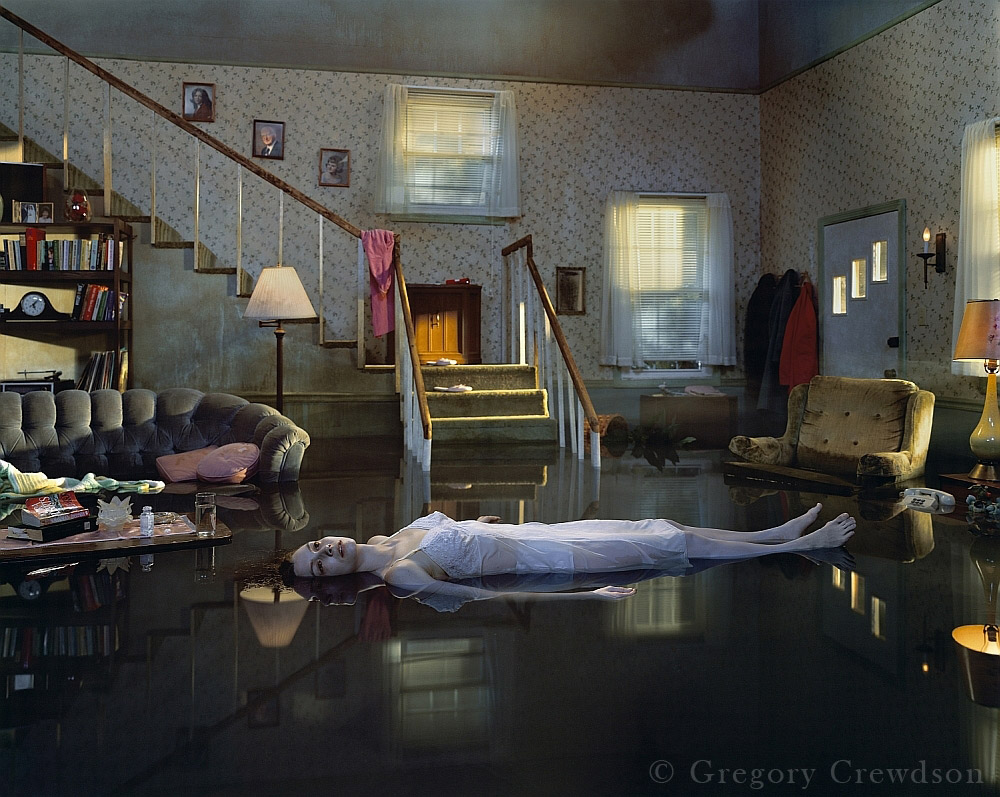
Gregory Crewdson

Absolutely mesmerised by Gregory Crewdson's photography, from the book 'Moving Pictures' - Contemporary Photography and Video from the Guggenheim Museum Collections. As soon as I saw the pictures, I immediately thought 'David Lynch' from the lighting, and the positioning / angles of the camera shots and the subjects. Indeed a paragraph from the book states that 'His elaborately staged panoramas often elicit comparisons to the films of Alfred Hitchcock, David Lynch, and Stephen Spielberg.'

Unlike my previous post, where I attached pictures that I associated with life, these works seem to portray the exact opposite. What  I like most about them are the long shots being used, and the importance of the ambience around the people - rather than basic the sole focus on the people themselves. I also find the lighting spectacular (apparently Crewdson has recently employed a crew of up to thirty-five to assist in the creation of his visions).

"In Crewdson's work, meaning if kept just out of reach, where it lurks like a repressed trauma." 
(Moving Pictures, 2003)


Monday, 2 May 2011

His & Hers

After speaking to a friend about the project I'm doing, she suggested the following documentary, which I think I will watch in the coming weeks mostly to observe the storytelling and the way it is portrayed in the shots.

Saturday, 16 April 2011

open-ended is exciting but scary

Every since I've been threading on this open-ended path on my project, it has been changing immensely. I'm not sure if it's good or bad but every time I go back to previous pages on my sketchbook, they start to make less and less sense, so I guess it's good.

I have been looking at one of the exhibits at 'Touch me' specifically Touch me I and II, Yoko Ono's April 2008 exhibition in New York.

Below are the instructions taken from Yoko Ono - Touch me (Charta, 2008)

touch me I

Take a photo of your body part reaching out from the openings.
Make a choice:
1.keep the photo
2.discard the photo
3.pin the photo up on touch me II
4.put a message underneath your photo
5.ask a friend to put a message underneath your photo.

y.o. '08

touch me II

touch me I

touch me II

touch me I
I like how something so simple triggered such a response and such a interesting result on touch me II.
In my last post I said I wanted to show some videos to people and see their response regarding the video. What I didn't like about this idea is that it was centred too much around the video, and less around the people. Today I was thinking about putting the focus more on the people and their stories. Should their stories to connected or separate from the video/visuals? Separating them from the video makes the whole project even more randomised than it already is, connecting them obviously provides a clearer link to whoever is watching, which could be nice - but misses the point of the whole project.

So now I'm left with two things to do.

1. Find these individuals and start collecting stories.
2. Think about what the content of the videos / visuals is going to be.

My idea at the moment is to just get abstract shots through video & connect with the visualisations, but perhaps to include some shots of people searching for meaning / doing meaningless things in everyday life . Anyway, whatever I do - I need to start testing these things out next week.

I think now I'll go make myself some coffee.

-------------------
(10 minutes later)
Slightly more ambitious (because I'm bad at programming) I've been thinking about this idea but avoiding it, but here goes: what I really want to do is to have the project online so that more people can include their stories via a database which then updates the stories to include the new ones. I will try to find someone who understands these applications and see if this is at all feasible.