I'll start this post by including some screenshots from my latest video:
I hope these images speak for themselves. The video is simply a 1 minute take of a couple sleeping together. In the last few seconds we can see another hand coming from behind the girl. I'm quite happy with the video because I think it managed to capture the essence of the story in just one shot. I also like the fact that the last few fames make it slightly humorous. The story was not filmed with the heads cut off but I felt that the identity of the couple was not needed, especially of the guy at the front, who all of sudden loses a bit of importance once the other hand is introduced.
Ok so aside from this, this week I am 'shadowing' two German lecturers at my college who are teaching and experimental film module to the BA Media students. Shadowing basically means I have to see what they are doing so once they leave I can carry on the lectures myself, and I can teach the module next year (most probably). Although most of the examples given in class are familiar to me, I have come across certain works that I hadn't seen before and that I have found to be interesting and even relevant to my Masters projects.
"A Movie is a 1958 experimental collage film in which Bruce Conner put together snippets of found footage, taken from B-movies, newsreels, soft-core pornography, novelty short films, and other sources, to a musical score featuring Respighi's The Pines of Rom" (youtube, 2012)
"Directed by Peter Mays. A sight/sound combine of exotic imagry shot semi-randomly in superimposition off a TV and then cut to make a fast moving but extremely ambiguous "story". GORILLA moves through modern man's myth mind like a runaway train bursting at the seams. Prize at Ann Arbor Film Festival, 1967." (youtube, 2012)
Harry Smith's drug inspired mirror animations.
Besides the history of experimental film we are also having discussions about 'experimental' film in general, such as the fact that dreams are one ways to be experimental in traditional films as they are purely surreal and therefore allow for plenty of ways to portray the distortion of time. We also discussed the difference between MTV style editing and experimental; MTV being for the masses (albeit the young generation masses) whilst experimental is more personal and much more risky. One of the lecturers expressed that common everyday youtube videos are perhaps closer to experimental than music videos, although the pity is that the subject is always the same; cats / accidents / food / sports, since most people like the same things.
The subject of minimalist and reduction was of course a prominent one, where the lecturers constantly told the students to reduce to the extreme. They told them how minimal projects are often not taken seriously by the viewer, however they are extremely difficult to copy and reproduce because they are so simple, that a project which is even remotely similar, cannot be said to be inspired from the original since the concept is so minimal. Therefore this makes minimal experimental art rather unique. They gave us an example of Paul Sharits' Ray Gun Virus, that was essentially an experimental film using just flickering colour. The point here was not to tell a story but to instigate a mood, and the conclusion was that if a visual piece manages to change the viewer's mood, then it has definitely done its job.
Ray Gun Virus (with sound!)
1966
According to artist, sound is to be turned to max volume.
"Although affirming projector, projection beam, screen, emulsion, film frame structure, etc., this is not an "abstract film"/projector as pistol/time-colored pills/yes=no/mental suicide and then, rebirth as self-projection. "... just colors and strobe ... 'light-color energy patterns (analogies of neural transmission systems) generate internal color-time shape and allow the viewer to become aware of the electrical-chemical functionings of his own nervous system' ... It's true." - David Curtis, International Times "RAY GUN VIRUS is a work in which no images appear yet one can get pure identity on film. ... projected film itself makes the viewer aware of where he stands. RAY GUN VIRUS is not so-called 'Psychedelic Cinema' but even more and goes beyond it through Sharits' bright clarification of the media." - Takahiko Iimura, Film Art Exhibition: Fourth Int'l Experimental Film Competition, Knokke-Le-Zoute; "Twenty Years of American Personal Film" anthology, National Museum of Modern Art, Tokyo, 1966. Collections: Museum of Modern Art, NY; Royal Archive of Belgium." (youtube, 2012)
Finally I will be creating a "Manifesto" category in my blog to explain the boundaries and rules of my project, and to define exactly why I have chosen this process and what I am expecting from the viewer.
Showing posts with label Inspiration. Show all posts
Tuesday, 15 May 2012
Sunday, 4 December 2011
Just my argument explained in pictures from the web
During short breaks from my research paper, I was browsing some unrelated funny websites just to clear my head for a few minutes. Strangely enough I still found some posts that reminded me of my research question. Below are a few funny / thought provoking posts. Resources can be found in the captions.
![]() |
| from 9gag.com - repetitive story structures in traditional cinema |
![]() |
| 9gag.com - how new technologies are being given more importance than the story |
![]() |
| 9gag.com - games taking over cinema, even in storytelling |
![]() |
| postsecret.com - absence of meaning / chance |
Wednesday, 26 October 2011
An inspirational quote
Came across this today....
"Cinema, which was the key method to represent the world throughout the twentieth century, is destined to be replaced by digital media: the numeric, the computable, the simulated. This was the historical role played by cinema: to prepare us to live comfortably in the world of two-dimensional moving simulations. Having played this role well, cinema exits the stage. Enters the computer."
From Cinema and Digital Media - Lev Manovich
Wednesday, 12 October 2011
The missing link...
So there was one element which wasn't particularly making sense in my project (well... perhaps more than one) but this was was annoying me because it just had nothing to do with the idea of chance, and just picking bits and pieces and putting them together to form some kind of meaning (or not).
This was the music. I felt that just finding ready made pieces of music and 'throwing' them in my interface would be too easy. Too easy in the sense that music facilitates the manifestation of emotions and meaning generation; therefore asking someone to give a piece of music would just take over the whole project.
So instead I have come up with another mini project which involves sound. My idea came from this 'Secondhand Sureshots' video that I had come across around a year ago.
"This documentary film by the dublab.com creative collective is an experiment in sound recycling. Secondhand Sureshots features four amazing, LA-based beat makers: Daedelus, J-Rocc, Nobody and Ras G in a secret mission to create new musical magic from the dusty remains of thrift store vinyl. dublab.com/secondhand"
So I thought what if I did something similar, but based on Chance?
The idea is this:
Two of my friends who are both vinyl collectors, and also have a vast library of samples will be creating one looping piece for the interface.
They will be choosing a number of vinyls (not decided yet) by Chance! (the method has still not yet been decided).
They are allowed to add other layers, pads and effects however the body of the musical pieces has to be composed from samples from vinyls picked by chance, to complement the rest of the project.
The 'music' piece, (and I say 'music' because they might just be ambient sounds and effects) will be presented in separate layers where the user can turn them off and on at the same time or choose which layers to have on and which to leave off. The menu for the interface has not been decided upon as of yet, but it will have to complement the recordings menu.
I will be recording this mini sound project and presenting it as well. I'm just curious to see how this will all turn up. This is the great thing about chance; it makes you feel excited for what's about to happen; for what is unexpected.
Tuesday, 9 August 2011
Demdike Stare
Had a brief break this weekend since a few of my friends brought Demdike Stare to perform Malta! I was very interested in their visuals during the performance, which are mostly sampled from Horror B-Movies and experimental film.
I would describe their visuals as evil, sexual, satanic, and also beautiful, mesmerising and hard to forget. It was a nice boost of inspiration.
In the meantime, I have recieved my books and I have started reading David Lynch - Catching the Big Fish. I am already finding some very relevant information, and the book itself is very easy to read.
Friday, 29 July 2011
Inspirational Material & Animation
I'm just back from London, where I went mainly to attend the 'I'll be Your Mirror' ATP Festival curated by Portishead. I must say that even though this was meant to be a break for me, I couldn't help but be inspired by the visuals presented by the artists.
The praxinoscopes were actually used in a music video here:
Frame by frame seemed to be a popular medium. Portishead had 'The Rip''s frame by frame (although quite a low frame rate) playing in the background during the performance of the song.
On another note, Joan of Arc performed with 'The Passion of Joan of Arc - 1928' in the background. This kept everyone glued to the screen. Later on the festival booklet I read that the film consisted mainly of close-ups yet still managed to convey the story through the actors' excellent portrayal of emotion. The below video might not play correctly- click to go to the youtube link, there's the whole film on youtube in parts.
Finally, I have also been to two exhibitions - Miro at the Tate Modern, and Tracey Emin at Southbank. This is the first exhibition I have seen by Tracey Emin and I must say it truly leaves a mark of whoever views it. Her works are personal and raw. I found the video of her dancing to be very inspiring and natural. I haven't found it on youtube, so head to Southbank and watch 'Why I never became a dancer' (or something similar...)
As for Miro, I have seen his works before, however this time I was more intrigued by his drawings - the simple black on white pieces, rather than his usual primary coloured material.
And the research paper will be tackled on Monday - although I have made progress on the title :)
There was an installation by David Wilson which made used of old fashioned praxinosopes. I filmed a couple of them:
The praxinoscopes were actually used in a music video here:
Frame by frame seemed to be a popular medium. Portishead had 'The Rip''s frame by frame (although quite a low frame rate) playing in the background during the performance of the song.
On another note, Joan of Arc performed with 'The Passion of Joan of Arc - 1928' in the background. This kept everyone glued to the screen. Later on the festival booklet I read that the film consisted mainly of close-ups yet still managed to convey the story through the actors' excellent portrayal of emotion. The below video might not play correctly- click to go to the youtube link, there's the whole film on youtube in parts.
Finally, I have also been to two exhibitions - Miro at the Tate Modern, and Tracey Emin at Southbank. This is the first exhibition I have seen by Tracey Emin and I must say it truly leaves a mark of whoever views it. Her works are personal and raw. I found the video of her dancing to be very inspiring and natural. I haven't found it on youtube, so head to Southbank and watch 'Why I never became a dancer' (or something similar...)
As for Miro, I have seen his works before, however this time I was more intrigued by his drawings - the simple black on white pieces, rather than his usual primary coloured material.
As for my own work - I have been storyboarding, filming and animating. Here's my latest frame by frame experiment - which will be finalised after I finish the story's filming on Sunday (fingers crossed).
Some pictures of my storyboard sketchbook:
| The growing list of stories |
| Red = storyboarded, a long way to go! |
| One of these is filmed, one will be filmed on monday |
| mixing animation with video - two complex stories |
| thinking about interaction |
| before I got my storyboarding sketchbook, I couldn't resist! |
| Storyboarded yesterday |
Monday, 18 July 2011
Considering interaction...
One of the most important aspect of my project is interaction - however it is also an aspect that I have been struggling to incorporate with the other media. On Saturday I posted a frame by frame Flash animation that I am currently working on, and I also included an FLV video in the 'window' of the animation.
Today I continued working on it some more, and started thinking about what the video could actually include. The animation is filmed on a very short story about a woman from Cyprus who moved to the UK years ago and spent the majority of her time crying in bed because she missed her country. I felt including any other video in the window would not add anything to the story or animation.
So I was thinking what if I included a video of another story inside the animation? Then, what if I can click on that video and be directed to another story? This would create an interesting link where the user can click through to move from one story to another. The project would be much more flowing I suppose, and more connected.
![]() |
| Still animating frame by frame |
![]() |
| Youuutuuube - an interesting visualisation controlled by mouse, arrow keys and space bar |
![]() |
| Works by Rafael Rozendaal - an interesting take on interactive visuals online |
Saturday, 18 June 2011
Earth Intruders
A friend linked me to the above video yesterday. I found many elements in common with my experiments, the distorting sky and the silhouettes and the superimposed video- worth looking into.
The video above is an inspiration for the kissing frame by frame animation I'm planning on doing this week. It won't necessarily be as detailed, but none the less it is traditionally shaded animation.
Thursday, 16 June 2011
Reflective Writing on Chat Session
Slightly late chat reflection but none the less, the discussion was about making art from found media; music, videos and art from the internet. This immediately got me thinking about sampling. I found this website called 'Thru You' where various musicians on youtube are sampled together to make up one song. Click on any of the images to be directed.
Friday, 27 May 2011
The Thomas Beale Cipher + experiment
During my MDR, Jonathan posted a comment by Jedrzej suggesting 'The Thomas Beale Cipher'.
I examined closely the use of moving textures and noticed a flickering effect throughout the short film. I decided to try out a similar effect on my last experiment.
I rendered this quickly and realised that I actually stretched the 'old film' effect using time remapping, rather than looping it. The gelatin wiggle effect was also a bit too much.
Besides that however, the texture did give more life to the video as a whole. I will try to get more abstract shots which I can then overlay onto videos.
Wednesday, 11 May 2011
William Kentridge
When I am interpreting recordings, I don't want to be restricted to film only what's around me. This is why parts of my visuals are going to have to be animated in several different ways. I was therefore looking at William Kentridge's works today. I love the charcoal animation effect, this also reminded me of Mariana's recent post where she did some tests with charcoal and animation. I always find that traditional techniques give life to digital animation.
"Kentridge's animated films are composed from his charcoal and pastel drawings, which he vigorously reworks, leaving traces of erasure, redrawing, and often highly visible pentimenti." (Moving Pictures, 2003)
I am currently uploading a very quick animation test I did in After Effects - it will hopefully be up by tomorrow morning. I have had to use found images just to quickly see how it would all look. I will try to recreate something similar using my own footage and pictures.
Thursday, 5 May 2011
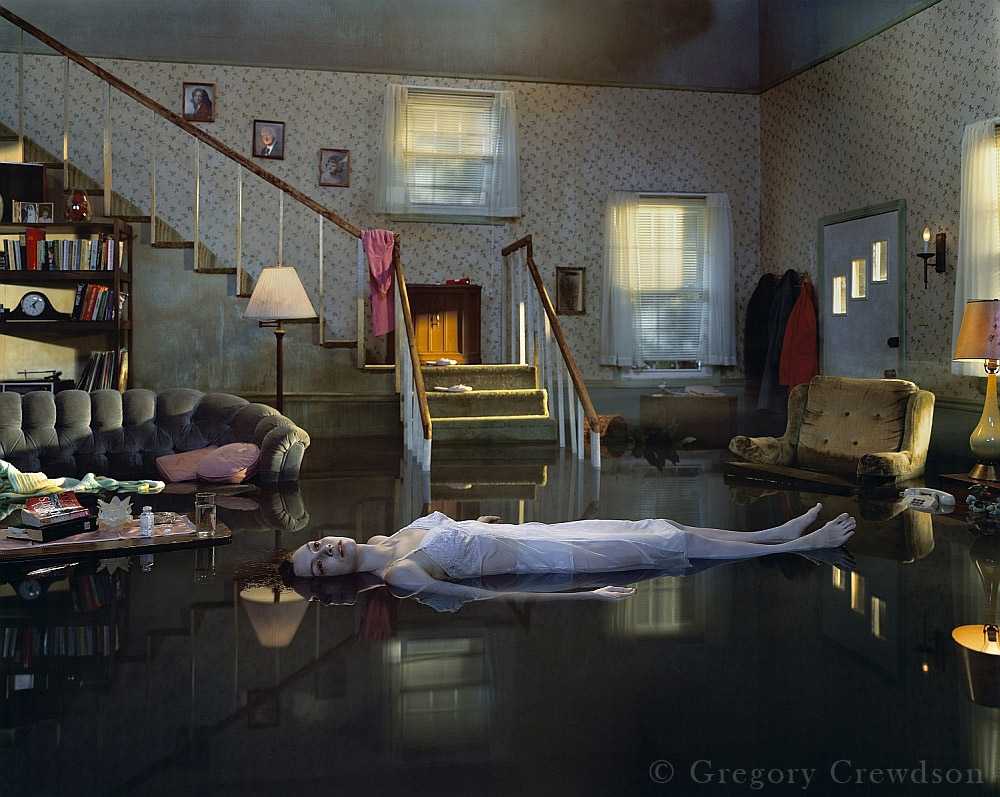
Gregory Crewdson
Absolutely mesmerised by Gregory Crewdson's photography, from the book 'Moving Pictures' - Contemporary Photography and Video from the Guggenheim Museum Collections. As soon as I saw the pictures, I immediately thought 'David Lynch' from the lighting, and the positioning / angles of the camera shots and the subjects. Indeed a paragraph from the book states that 'His elaborately staged panoramas often elicit comparisons to the films of Alfred Hitchcock, David Lynch, and Stephen Spielberg.'
Unlike my previous post, where I attached pictures that I associated with life, these works seem to portray the exact opposite. What I like most about them are the long shots being used, and the importance of the ambience around the people - rather than basic the sole focus on the people themselves. I also find the lighting spectacular (apparently Crewdson has recently employed a crew of up to thirty-five to assist in the creation of his visions).
"In Crewdson's work, meaning if kept just out of reach, where it lurks like a repressed trauma."
(Moving Pictures, 2003)
Documentary Photography
Since I've changed my proposal, I visited the library at the art college (where I work) today to try and find some new inspirational material which involved more photography and video works. I picked up three books, Documentary Photography - Life Library of Photography, Doris Chase Artist in Motion, and Moving Pictures - Contemporary Photography and video from the Guggenheim Museum Collections.
I started looking at 'Documentary Photography - Life Library of Photography' and the following pictures are what I've found most inspirational, and perhaps - more related to what I want to do:
What struck me most about all of the above pictures is the 'life' in them, because they are all about people - together in groups, during festivals and parties. They reminded me of the weekly Festas we have in Malta all throughout the summer, and I was wondering if I could get a couple of shots and videos during these events.
I started looking at 'Documentary Photography - Life Library of Photography' and the following pictures are what I've found most inspirational, and perhaps - more related to what I want to do:
![]() |
| Dan Weiner Street Festival |
![]() |
| Lee Friedlander New York City |
![]() |
| Cid Grossman |
![]() |
| Cid Grossman |
![]() |
| Cid Grossman San Gennaro Festival |
Sunday, 2 January 2011
Purbeck Light Years by Jeremy Gardiner
'This digital artwork is a three dimensional temporal arena which evokes a calm, receptive state of mind. A mixture of both old and new, hybrid techniques that combine characteristics of painting and drawing, computer animation and immersive VR. Inside this virtual space is re-imagined a whole world, a topographical landscape of Corfe Castle modelled in three dimensions, silent and secret, a place of accumulated history."
Wednesday, 29 December 2010
Cosmogramma
One of the artists I will be researching, Leigh, J. McCloskey
Sunday, 26 December 2010
Silencing the Sounded Self
A few months ago I found a book called 'Silencing the Sounded Self - John Cage and the American Experimental Tradition' by Christopher Shultis in a second hand Art bookshop in Malta. I bought it after skimming through a few pages because I thought it might be useful for my research. I started reading it this weekend. So far it has helped me see the difference between a Coexisting experimental artist, and a Controlling experimental artist - it also explains in detail what is meant by experimental artists (musical artists in the case of this book - but it can also apply to visual artists). Essentially something that has no goal; something open to the unintentional. The beautiful thing about it is that it encourages exploration of the unknown, and I think that having no precise goal and no tight restrictions will result in a much more organic and genuine project.
I have also come across an artist that I had not heard about before; Christian Boltanski. I haven't read a lot about him so far, but I am currently looking at some of his work on youtube.
Sunday, 19 December 2010
What I am reading...
I am currently reading "Contemporary practices - Art as Experience" by Paul Ardenne, Pascal Beausse and Laurent Goumarre (translated from French)
Although I am finding it slightly difficult to read, I can understand what the authors are trying to say. I guess the final paragraph of the books sums it up quite nicely:
"By putting himself in a position of not knowing, of learning- and not of refusing to know- the artist treats the fragile conditions of 'initiation' and 'reception' together on the same level." Thus the dynamic, project, issues and subject of the deceptual work are to be found in this relation, and not only in a reception and response that occur after the event."
The book talks about the constant struggle of the contemporary artist to try and innovate - however reminds the artist to not forget about the very essence of art - communication with the audience - involvement and interaction of the audience. The audience will be of major importance, in fact, the focus of my project. I must avoid the very tempting trap of appearing to be an all-knowing artist, and instead involve my audience, show them I am still learning, and give them as much flexibility in the project as possible (yes, even if this involves more programming - it must be accomplished).
Today I have also started some research on Brion Gysin - I am almost embarrassed to say I have only started looking into his works today, as he was a huge influence on the Beat Generation (especially having created the Dream Machine). In an Interview for 'The Guardian' in 1997, William Burroughs said that Brion Gysin is "the only man that I've ever respected in my life. I've admired people, I've liked them, but he's the only man I've ever respected."
So now I have a copy of a 1982 RE/Search Magazine on William S.Burroughs, Brion Gysin and Throbbing Gristle.. and I'm going to try and read it all by the end of next week. Will post more reflections soon.
In the meantime my proposal has been shifting and changing. Evolving, I'd like to think.
Thursday, 21 October 2010
Who is Lenore Jaffee?
For the past two days I have been researching beat artists, and have come across 'Lenore Jaffee'. Unfortunately I cannot seem to find any detailed information about her, except that in the late fifties she exhibited her paintings at the Phoenix Gallery on 10th Street in New York City. (www.beatmuseum.org) The article also states that she is a "...significant pioneer amongst American Women abstract painters". (click to view original mini-article)
![]() |
| Goddess, 1959 - Lenore Jaffee |
Tuesday, 19 October 2010
Franz Kline and the Cosmic Kitchen
Jack Kerouac(played by Vincent Balestri in 'Beat Angel') relates the wisdom of his friend, painter Franz Kline.
So after yesterday's weekly chat I was trying to think how I can narrow down my theme so it's much less vague. I'm now trying to see the space I want to create as kitchen where the user can 'cook' art and music and mix and match them together. The words 'Cosmic Kitchen' keep playing around in my head because it's not just your everyday kitchen but it's an audiovisual kitchen.
All the mixing and matching of audio and visuals got me into collages and these two days I have been collecting various samples of material as well as magazine cutouts which I will try to assemble into interesting compositions to see where they will take me.
I have also started researching some abstract expressionists and came across Franz Kline. I absolutely love his work because it is so minimal and yet so powerful. I'm not sure whether I could translate this kind of style into my own work but I am definitely a fan of how he mixed white and black to create grey/dirty areas.
"Yet Kline's art is anything but black and white. If his work is boisterous, it is also silent. If it is a celebration of unfettered movement, it is also a scar. If it is filled with suggestions of windows and doors, those windows and doors have often been boarded up or slammed shut. If his paintings are abstract and irreducible, they also seem like maps charting a lifetime of journeys through rural and urban America, popular and high culture, American and European art." NY Times
Tuesday, 12 October 2010
Teebs
So currently I'm just exploring artworks from various sources just to get inspirations and ideas. Very interested in teebs who's both an artist and an experimental Hip Hop musician. I'm intrigued by his work because he makes music and designs, something I'm looking into in my proposal.
I'm just trying to find some interviews to see how he manages the audio/design process, not much luck so far though;
Do you mix both music and art together to picture a visual sound or painting?
I dont try to mix the two like that…but they do resemble each other…its more of a natural process
(from: Fried My Little Brain)
![]() |
| I really love the mixed media in this, loads of contrast in tactile qualities, texture, line and colour. |
![]() |
| The pink triangle makes the whole composition more minimal and modern. |
Subscribe to:
Posts (Atom)